The problem with prompting (even “good prompting”) and skills
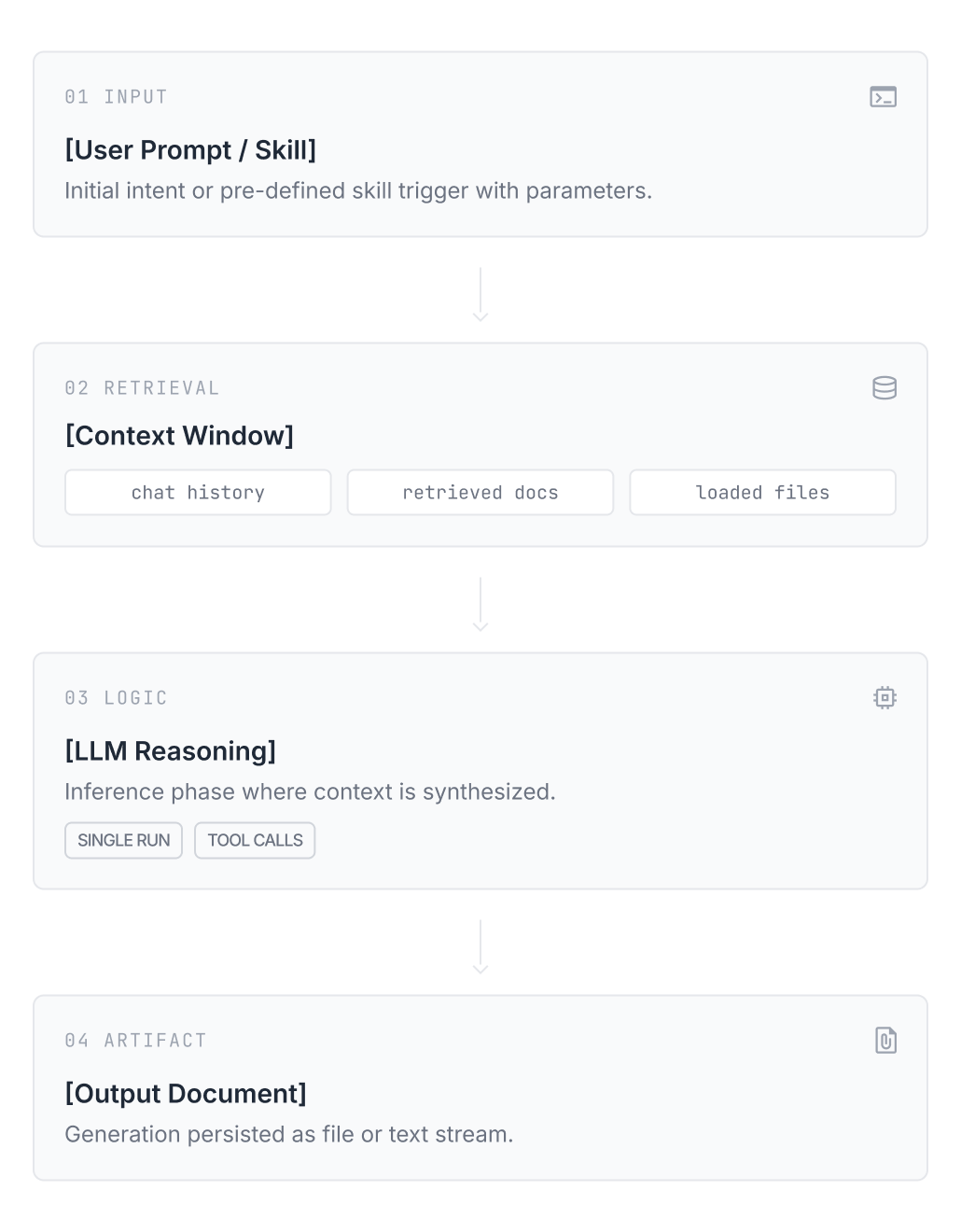
When you use a general AI environment (prompting or Skills):
- You provide instructions + some context (docs, files, snippets).
- The model reasons within a context window (bounded tokens).
- It outputs a result (doc, list, draft, plan).
Even if the environment can access files, the “understanding” is not stored as a reusable market model. On the next run, you either:
- re-load context, or
- accept partial memory and re-explain.
Net result: outputs are strong, but the system doesn’t accumulate a structured market understanding unless you manually maintain it.
What “agentic” means here (no buzzwords)
An agentic framework is not “a longer prompt.” It’s a system that:
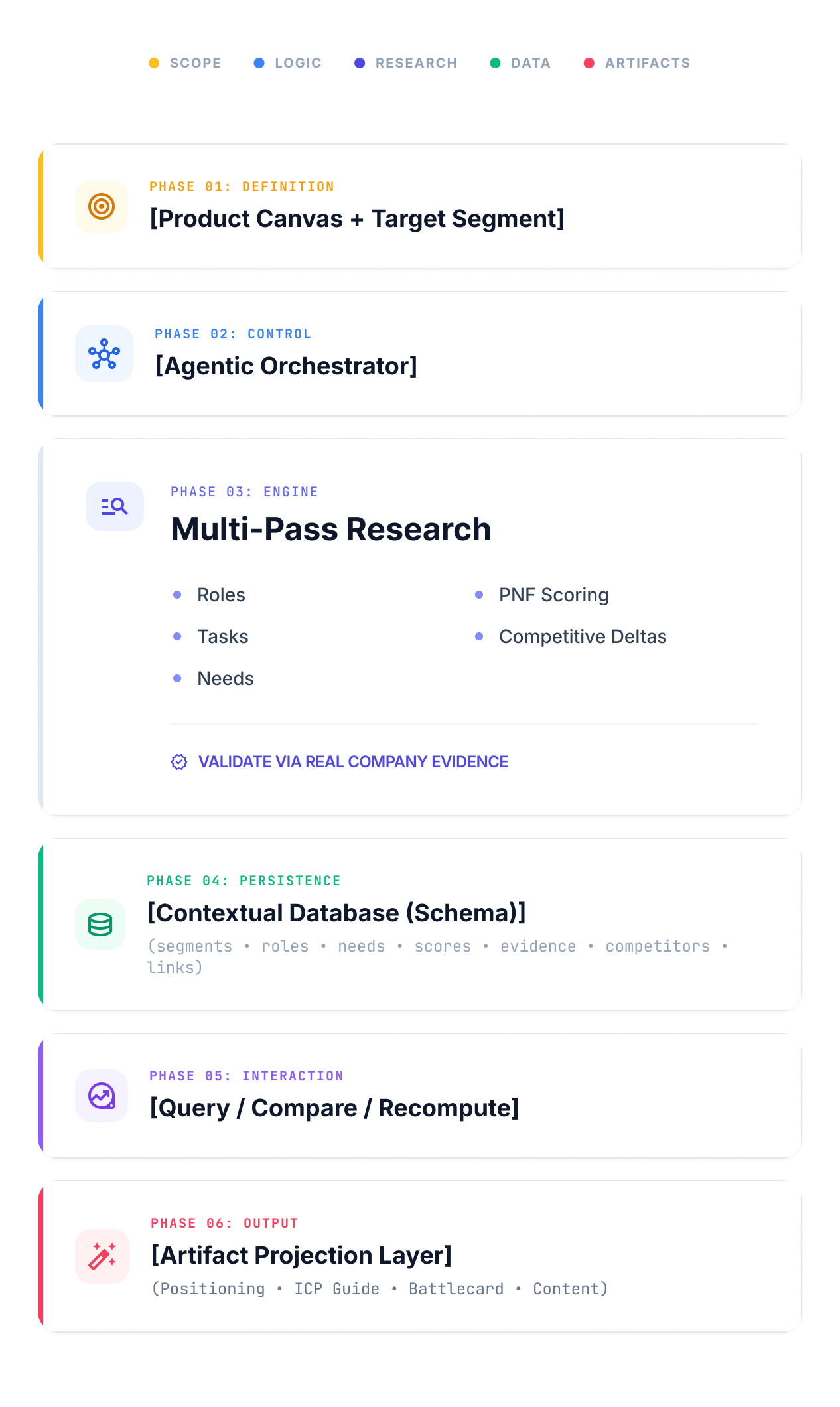
- Decomposes the work into multiple research/computation passes
- Stores intermediate results as structured entities
- Retrieves those entities later for analysis and comparison
- Recomputes selectively when inputs change
- Projects outputs from the stored model (instead of generating everything from scratch)
This changes the foundation:
- Prompting/Skills → generate an answer per run
- Agentic framework → build and maintain a decision model over time
Product-Need Framework (PNF): what it computes
PNF is the evaluative core that turns market research into prioritization.
Inputs
- Product Canvas (capabilities, scope, constraints, value themes)
- Target segment(s)
Multi-pass research
PNF doesn’t do “one big generation.” It breaks the problem into layers and runs an operation equivalent to 1000+ prompts in a single segment PNF scoring:
- Identify relevant roles in the segment
- Derive impacted task groups per role
- Extract needs/challenges tied to those tasks
- Map needs ↔ product capability coverage
- Capture competitive alternatives and deltas (optional but common)
- Validate signals via real company evidence (advanced research)
Scoring and ranking
Needs are scored on explicit dimensions (your current PNF framing), e.g.:
- business criticality
- operational criticality
- breadth of impact across roles/departments
- frequency of occurrence
Then PNF produces:
- A ranked need set per segment
- Comparable scores across segments
- Stored rationale and evidence links (where applicable)
Important: the ranking is not just printed. It’s stored as reusable intelligence.
The real difference: where intelligence lives
In prompting / Skills
- Intelligence is reconstructed inside the context window each run.
- You may store documents, but the system does not store computed relationships like:
- Segment → Role → Task → Need → Score → Evidence
- Outputs have to become the “source”
In PNF agentic systems
- Intelligence is stored in a contextual database with a domain schema:
- segments, roles, tasks, needs, scores, competitors, evidence
- Relationships are first-class objects.
- Outputs are generated from this stored model.
Practical implication: you don’t have to re-derive and re-align everything each time.
Why Skills are not “multi-agent” in the way that matters
Skills can be:
- multi-step,
- tool-using,
- consistent.
But typically:
- the system still runs as a bounded execution flow,
- reasoning happens inside a context window,
- intermediate results don’t become a persistent market model unless you build that layer around it.
So the clean technical stance is:
Skills can execute workflows.
Agentic frameworks build persistent, recomputable intelligence.
What this enables in day-to-day PMM work
Because PNF stores structured intelligence:
- Update once → regenerate many
Update the latest product versions → run the segment research and update the segment 360 → regenerate positioning, enablement, and any content from the updated ranked needs in the segment. - Compare segments without re-researching from scratch
Same scoring dimensions → consistent benchmarking. - Granular edits, not full rewrites
Select a specific need, role mapping, or evidence node rather than rewriting entire docs. - Explainability by trace
“Why is this ranked #1?” → show the stored scoring dimensions + evidence.
This is not about “better writing.” It’s about maintaining a living market model.